Dewatering for Marine Wall and Bridge Infrastructure in Florida & South Georgia
Avg. Read Time: 4 min, 20 sec
The True Story
Short on time? Here are this article’s key takeaways…
Dewatering is the foundation of success for marine retaining walls, bridge abutments, and wing walls in Florida and South Georgia.
When water is suspected of being present on a site, a local geotechnical engineer should evaluate soil conditions, groundwater behavior, and permitting requirements before construction begins.
High water tables, sandy soils, tides, and storms can destabilize excavation zones and compromise wall performance if not controlled.
Proven methods like cofferdams, wellpoints, bypass pumping, Kelly wells, and sediment control create a stable work zone and protect long-term infrastructure performance.
Disclaimer: Engage a Geotechnical Engineer
Construction near water is inherently complex and potentially hazardous. This article provides general information on dewatering and marine retaining walls, but it is not a substitute for professional engineering guidance. Any project where water is present—or even suspected—requires the involvement of a licensed geotechnical engineer. They assess site-specific conditions, determine safe dewatering methods, ensure regulatory compliance, and minimize risk to property and personnel.
Any construction involving water brings unique challenges, especially in Florida and South Georgia, where high water tables, coastal tides, storm surge, and sandy soils are the norm. Protecting property and supporting infrastructure along rivers, canals, lakes, marshes, and stormwater detention/retention systems requires a durable retaining wall solution such as Redi-Rock or Novum Wall. This can also include bridge abutments and wing walls, where water, traffic loads, and long-term durability intersect.
One critical step often determines long-term success before the first block is ever set: site dewatering.
Consulting an engineer on any retaining wall project is always a good idea, but it becomes almost essential when water is involved. Whenever water may impact a site, a local geotechnical engineer should be engaged to evaluate risks, design requirements, and regulatory requirements. Dewatering is a complex process with numerous variables tied to soil conditions, groundwater behavior, and environmental constraints. This article offers a high-level explanation of dewatering and how it supports the installation of Redi-Rock and Novum Wall systems in wet or submerged conditions. It is not intended to serve as a step-by-step construction guide.
Why Dewatering Is Essential in the Southeast
Construction near water is always complex, but in this region, the challenges multiply. Higher water tables, loose soils, and sudden storms can quickly overwhelm a jobsite if not appropriately managed. Dewatering allows contractors to:
- Stabilize soft Florida and South Georgia soils for reliable marine retaining wall foundations.
- Create a dry, workable zone in areas with tidal fluctuations or standing water.
- Ensure proper alignment of Redi-Rock blocks or Novum Wall blocks.
- Protect the long-term performance of marine retaining walls and bridge infrastructure against washout or settlement.
Without it, walls face premature failure, and installation crews face unnecessary risks.
The Role of the Geotechnical Engineer
No two sites behave the same, especially across the diverse geologies of Florida and South Georgia. One project may encounter loose coastal sands, another dense clays, and another artesian conditions or underground flow paths tied to nearby waterways.
This variability is exactly why geotechnical engineers are indispensable. Their expertise ensures safety, constructability, regulatory compliance, and long-term performance.
A geotechnical engineer can:
- Analyze subsurface conditions. Soil stratigraphy, in situ soil characteristics, and groundwater behavior should guide all design decisions.
- Recommend the appropriate dewatering approach. Methods are tailored to site-specific soil and water conditions.
- Ensure compliance with environmental and permitting requirements. Critical in coastal and wetland-adjacent projects.
- Reduce construction risk. Proper planning minimizes failures, delays, erosion, and safety hazards.
For bridge abutments and wing walls, engineers also evaluate load transfer between the roadway, foundation soils, and retaining structures, making proper dewatering essential to long-term performance and safety.
In short, geotechnical engineers don’t just respond to water problems; they prevent them from becoming costly issues in the first place.
Common Dewatering Methods in Florida & South Georgia
Contractors working with Truemont often employ these strategies when installing marine retaining walls:
Cofferdams and Berms for Rivers and Tidal Creeks
Sheet piles or inflatable cofferdams isolate the construction zone, allowing water to be pumped out. These are especially useful for shoreline walls along rivers like the St. Johns or the Savannah, and are commonly used for bridge abutments and wing walls at roadway crossings, where isolating the foundation zone is critical. Building a berm with a Kelly well may be sufficient for applications near the mean high-water line. This Truemont-supplied project along the St. Johns River in Green Cove Springs, Florida, effectively used a berm-and-Kelly-well approach to manage a wet site.Wellpoints, Kelly Wells, and Sumps for Sandy Soils
In areas with permeable soils, like much of coastal Florida, wellpoint systems lower the water table while sump pumps handle seepage. This ensures a stable base for walls and a dry construction area for workers for large-scale stormwater or transportation projects.Bypass Pumping for Stormwater Flow
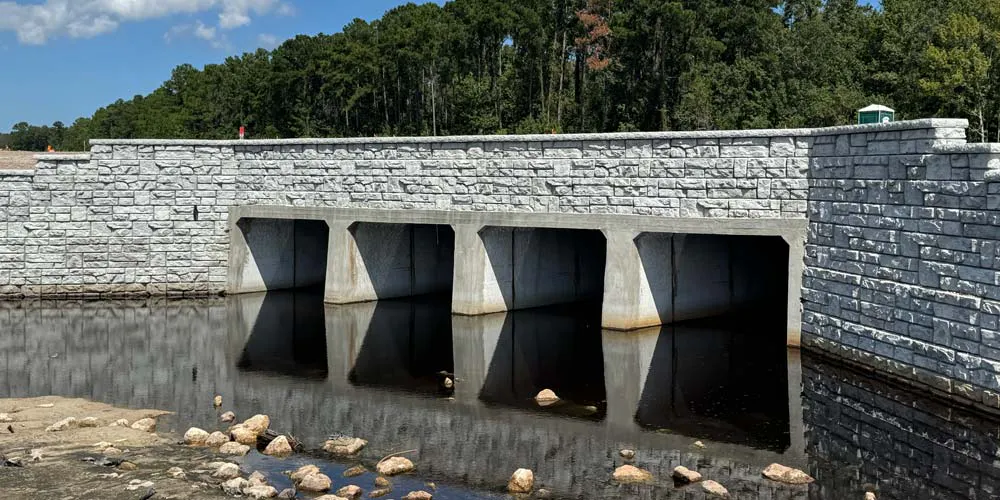
When walls are installed near outfalls or drainage channels, temporary bypass piping maintains flow while crews work safely behind the barrier. This is also frequently required when constructing wing walls near culverts or bridge drainage structures to maintain flow and roadway safety. Truemont supplied Redi-Rock headwalls and wing walls for a 4-box culvert crossing that required rerouting a small stream to facilitate installation.Sediment Control for Environmental Protection
Geotechnical engineers work with contractors to help projects meet permitting requirements, often incorporating filter fabrics and erosion control measures to protect sensitive waterways.
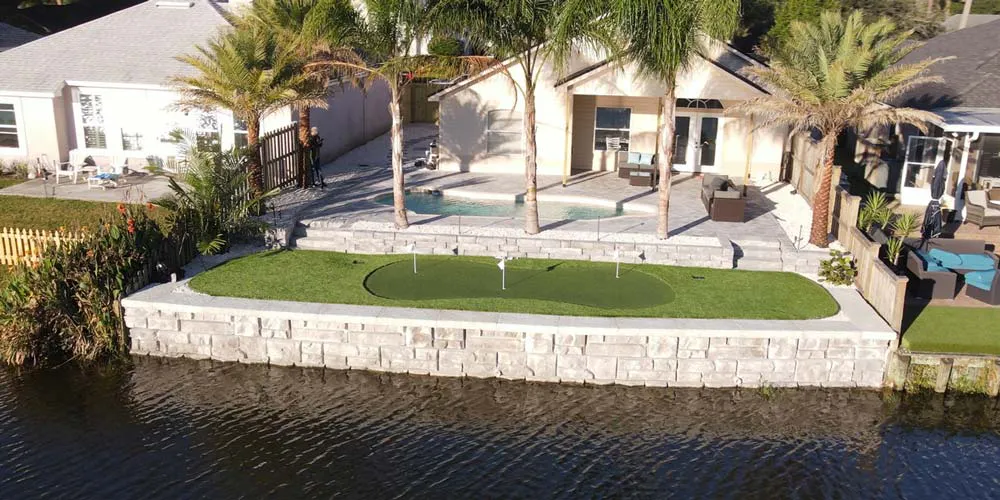
Sometimes, using the right equipment can eliminate the need for involved dewatering. For example, an Ormond Beach property on the Tomoka River was shored up with a Redi-Rock wall system supplied by Truemont. A Ho-Pac® (a heavy-duty, hydraulic, boom-mounted vibratory compactor/driver attachment attached to a backhoe) was used to vibrate #57 stone in a leveling pad in saturated conditions. This enabled the leveling pad to be installed without dewatering.
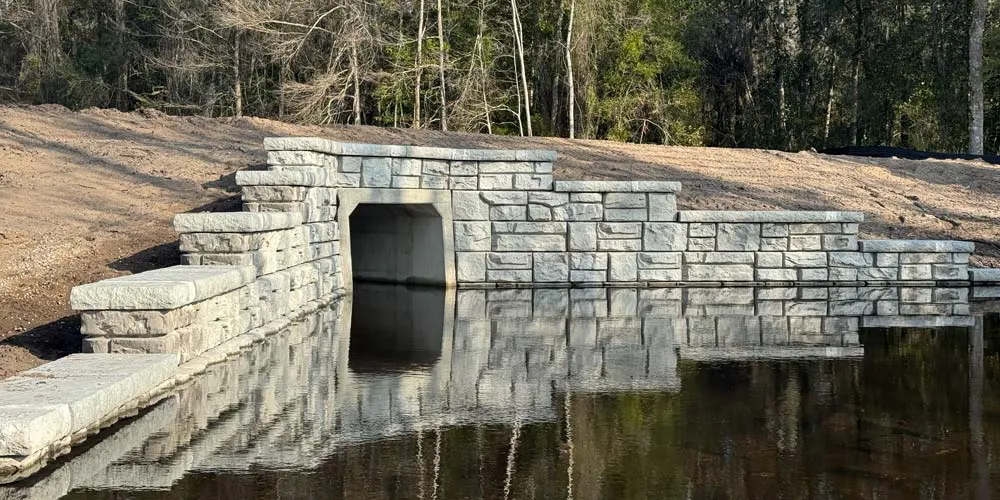
Marine Wall, Marine Wall, Bridge Abutment, and Wing Wall Installation After Dewatering
Once a site is stabilized and dewatered, crews can move forward with confidence, installing marine retaining walls, bridge abutments, and wing walls that support roadways, shorelines, and critical infrastructure, typically following these basic steps:
- Excavation and Subgrade Preparation. Proper compaction and grading provide a solid base.
- Base Installation. A granular leveling pad is placed to support Redi-Rock or Novum Wall blocks.
- Placement of Units. Precision installation is possible because water isn’t disrupting the foundation.
- Backfill and Reinforcement. Free-draining aggregate and geogrid or anchors are added per design, though reinforcement is rare for Redi-Rock or Novum Wall in our region. Sea wall solutions, like Truemont’s Coast Armor, generally require reinforcement, such as soil anchors, to prevent scour on deep-pile/panel walls.
- System Removal. After completing the retaining wall, cofferdams or pumping systems are dismantled, restoring natural water flow.
Why Partner with Truemont Materials for Walls in Water
Local expertise matters. Truemont Materials supplies the Southeast with proven retaining wall, bridge abutment, and wing wall solutions that perform in some of the region’s most challenging water and soil conditions. The Truemont team supports contractors and engineers with system knowledge, design resources, and logistical support to ensure projects stay on budget and on schedule, even when retaining wall and bridge construction requires careful water management. In many circumstances, Truemont can bring experienced designers and installers to local projects to provide a turnkey solution for your next project.
In Florida and South Georgia, dewatering is not just a step in the process; it’s the key to successful waterfront wall and bridge construction. Trust Redi-Rock and Novum Walls from Truemont Materials to deliver shoreline stabilization, flood protection, bridge support, and infrastructure solutions built to withstand the tests of water and time.